Little Angel 3D SVG: A Christmas Asset Review
First Impressions: Evaluating Visual Warmth for Client Work
When sourcing a graphic design asset for a seasonal client campaign, the initial emotional impact is just as critical as technical precision. Upon opening the Little Angel files, the immediate impression is one of soft nostalgia and refined innocence. This is not a generic, flat vector; it carries the distinct depth and shadow play characteristic of a high-quality 3D SVG. For a designer tasked with creating a visual identity for a boutique candle line or a handmade ornament shop, this asset immediately establishes a mood of premium craftsmanship rather than mass-produced holiday cheer.
The style leans heavily into traditional aesthetics but maintains clean lines that prevent it from looking dated. In a real-world scenario, such as designing packaging for a luxury tea brand’s Christmas collection, this illustration serves as an anchor. It communicates warmth without overwhelming the layout. However, because it possesses dimensional shading, it demands space to breathe. It is best suited for clients who want their brand identity to feel personal, artisanal, and emotionally resonant, rather than corporate or starkly modern.
Technical Versatility Across Cricut and Silhouette Platforms
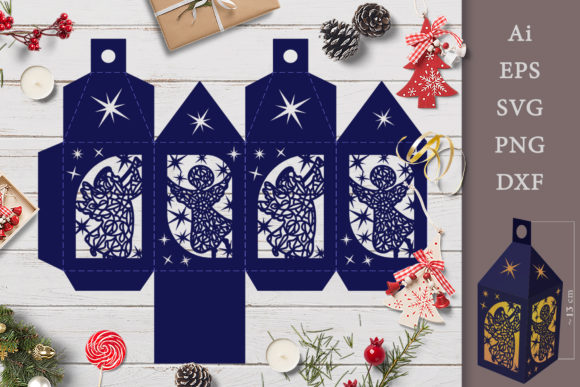
As a professional reviewing this for production, file compatibility is non-negotiable. The Little Angel package demonstrates excellent foresight by including formats compatible with Silhouette, DXF, PDF, and Cricut ecosystems. For those working in Cricut Design Space, the inclusion of a specific folder with notes is a crucial detail that prevents common layering errors often seen with complex SVG design files. This attention to user experience suggests the creator understands the friction points of Cricut project workflows.
For print-on-demand sellers and crafters using Scan-N-Cut or Silhouette Studio, the separation of cut lines from print layers appears robust. When testing the digital product for a client’s sticker line, the paths were smooth, minimizing the risk of jagged edges on physical products. This technical reliability makes it a safe choice for Etsy product listings where consistency across different buyer machines is vital. Whether you are producing vinyl decals for tumblers or cardstock ornaments, the vector integrity holds up under scaling, which is essential for maintaining professional standards in commercial design.
Strategic Applications in Packaging and Brand Identity
In a recent concept for a local bakery’s holiday gift boxes, Little Angel performed exceptionally well as a primary focal point on packaging design. The 3D nature of the graphic allows it to interact beautifully with textured paper stocks and foil stamping. Unlike flat clipart, the shading provides a natural guide for where highlights and shadows should fall if a designer chooses to add metallic accents manually. This elevates the perceived value of the handmade business branding.
Beyond packaging, this asset shines in editorial design and marketing collateral. Imagine a holiday lookbook or a seasonal blog header; the angel acts as a sophisticated visual break between text blocks. For social media graphics, particularly Instagram carousels or Pinterest pins promoting seasonal sales, the illustration draws the eye without competing with promotional copy. It works effectively as a recurring motif across a design bundle, helping to unify disparate marketing materials under a cohesive festive theme. For clients selling sublimation design products like mugs or tote bags, the detailed rendering ensures the image remains engaging even when wrapped around curved surfaces.
Navigating Layout Constraints and Visual Hierarchy
While versatile, Little Angel requires intentional placement within a visual hierarchy. Due to its intricate details and dimensional styling, it struggles in extremely small applications. Using this as a tiny icon in a website footer or a dense contact sheet will result in visual mud. It is not suitable for minimalist modern design projects that rely on negative space and geometric simplicity. If your client’s brand is ultra-corporate or tech-forward, this asset may create tonal dissonance.
Designers must also be cautious with busy backgrounds. Because the 3D SVG relies on subtle gradients to create depth, placing it over a high-contrast pattern or photograph can flatten the effect. It performs best against solid colors, soft textures, or ample whitespace. In logo design, it should serve as an illustrative mark or badge element rather than integrating directly into wordmarks, as the complexity could hinder legibility at favicon sizes. Always prioritize readability; if the angel distracts from the call-to-action in a digital ad, scale it back or reposition it as a supporting border element.
Essential Pre-Flight Checks for Commercial Projects
Before committing Little Angel to a final client deliverable, run through a rigorous quality assurance checklist. First, test the design in black and white. If the 3D effect disappears or the form becomes unrecognizable without color, the contrast ratios need adjustment for single-color vinyl cuts or embossing. Next, verify the commercial license terms explicitly. While the asset is perfect for small business branding, ensure your specific usage tier covers the intended volume of printable design sales or POD units.
Typography pairing is another critical test. Place the asset alongside potential fonts. Does it clash with a bold sans-serif, or does it harmonize with a delicate serif? For Christmas projects, traditional scripts often work well, but ensure the flourishes do not tangle with the angel’s wings or halo. Finally, always preview the file on actual product mockups before sending proofs. What looks vibrant on a calibrated monitor may shift when printed on kraft paper or fabric. Confirming these variables ensures that this creative design asset translates seamlessly from screen to shelf.
Optimizing File Formats for Diverse Output Needs
A significant advantage of this asset is its multi-format approach, which supports various stages of the creative marketplace workflow. The PDF version is invaluable for high-resolution print jobs like posters or flyers where vector crispness is mandatory. Conversely, the DXF files cater specifically to users needing editable cut lines for silhouette machines. For designers working in Canva templates or web environments, having a rasterized option (if provided or exported) ensures faster load times compared to embedding heavy vectors.
When preparing files for a client who will handle future iterations themselves, organization is key. Label layers clearly within the SVG design file. If the client is a Cricut user, remind them to consult the included notes regarding the specific SVG_Cricut folder. This proactive communication prevents support headaches later. By treating Little Angel not just as a pretty picture but as a functional component of a larger design system, professionals can maximize its ROI across t-shirt design, stationery suites, and digital campaigns alike.
Final Verdict on Professional Utility
Ultimately, Little Angel stands out as a robust tool for designers targeting the sentimental and artisanal sectors of the holiday market. Its strength lies in its ability to bridge the gap between digital convenience and handcrafted aesthetic. While it requires careful handling regarding scale and background contrast, its technical execution and emotional resonance make it a valuable addition to any seasonal design assets library. For projects demanding a touch of timeless grace backed by modern file versatility, this asset delivers professional results that satisfy both the designer’s standards and the client’s vision.